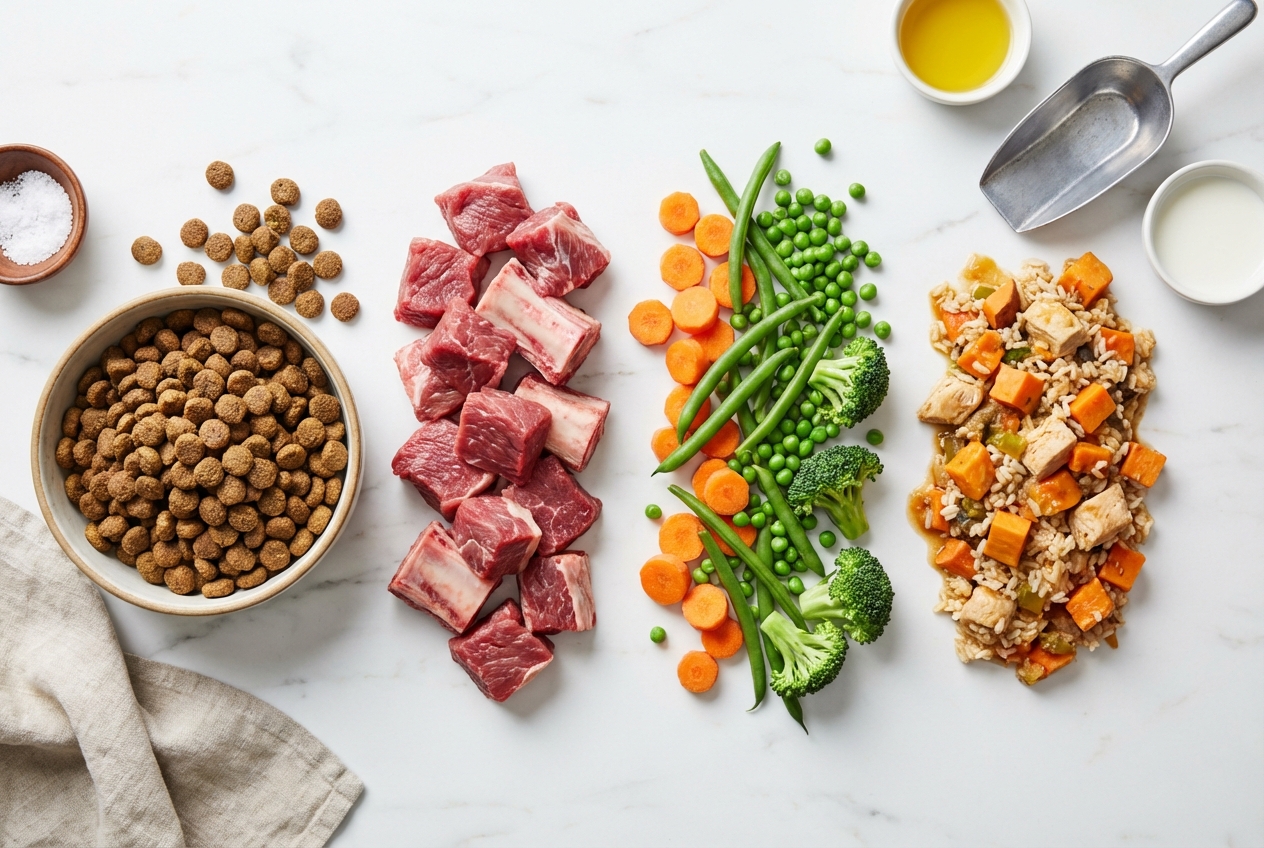
The ingredient panel lists items by pre-cooking weight, which creates some misleading impressions about what your dog is actually eating.
Dr. Lisa Freeman has spent the better part of her career at Tufts University's Cummings School of Veterinary Medicine studying one thing: what dogs are actually eating versus what owners think they're feeding. Her conclusion, repeated across papers and public lectures, is blunt. "Most dog food labels are technically legal and functionally misleading."
That's not an accusation of fraud. The regulations governing pet food labeling are real. The AAFCO nutrient profiles are science-based. But the gap between what those regulations require and what a shopper standing in a pet store aisle can meaningfully understand from the bag is wide enough to drive a truck through.
Here is how to actually read a dog food label.
The Ingredient List: What "First" Actually Means
Ingredients are listed by weight before cooking. Chicken, when it appears first on a label, weighs mostly water. A raw chicken breast is about 75% water. After cooking, that water evaporates, and the chicken shrinks to a fraction of its pre-cook weight. The grain or meal listed third or fourth may well end up contributing more dry protein to the food than the fresh chicken listed first.
This isn't illegal. It's how food labeling works in both human and pet food. But it explains why you can buy a bag that says "Chicken & Brown Rice Recipe" with chicken first on the list, and the finished food might contain more protein from chicken meal or plant sources than from whole chicken.
"Whole meats listed first are a marketing feature, not a nutritional guarantee," Freeman told a 2023 audience at the American College of Veterinary Nutrition symposium. "What matters is the overall amino acid profile and digestibility of the finished product, not which ingredient weighs more before it goes into the oven."
Meal vs. Whole Meat: The Real Story
Chicken meal gets a bad reputation because it sounds like leftovers. It's not. Chicken meal is rendered chicken with the moisture removed, concentrating the protein. A kilogram of chicken meal contains roughly four to five times the protein of a kilogram of fresh chicken. When you see "chicken meal" third on a list, it may actually represent more usable protein than the fresh chicken listed first.
The distinction that matters is named meal versus generic meal. Chicken meal is named. You know the species. Poultry meal is generic. It can include any bird, including spent laying hens with lower nutritional value. "Meat meal" is the least specific and least desirable, covering any mammal species, potentially including animals that died from illness or injury before processing.
"The words 'natural' and 'premium' on a pet food bag have no regulatory definition. Any manufacturer can use them. They mean nothing."
Dr. Lisa Freeman, veterinary nutritionist, Tufts UniversityNamed meals from a named species are a positive sign. Generic meal categories deserve more scrutiny.
Fillers: The Word That Misleads Both Ways
The pet food marketing world uses "filler" as a slur. Grain-free brands built entire campaigns around it. The problem: the term has no agreed meaning, and the ingredients it's applied to aren't uniformly bad.
Corn, for example, is frequently called a filler. Dogs digest cooked corn at about 85% efficiency. It provides carbohydrates, some protein, linoleic acid, and beta-carotene. Is it the optimal ingredient? Probably not. Is it an inert filler with zero nutritional value? No. The same applies to rice, barley, and oat meal, all of which appear on "filler" lists in some marketing materials and in actual veterinary therapeutic diets in others.
The grain-free movement replaced grains with legumes (peas, lentils, chickpeas) and potatoes. In 2018, the FDA opened an investigation into a potential link between grain-free diets high in legumes and dilated cardiomyopathy (DCM), a serious heart condition, in dogs. The investigation remains open as of early 2026, with no confirmed causal mechanism established. But the assumption that legume-heavy grain-free foods are automatically superior has not survived scrutiny. The evidence base for different diet types is murkier than most pet food marketing suggests.
What AAFCO Actually Guarantees
The Association of American Feed Control Officials sets nutrient profiles for pet food. A label that reads "complete and balanced" and cites AAFCO nutrient profiles means the food meets minimum standards for protein, fat, vitamins, and minerals for the stated life stage (adult, puppy, or all life stages).
There are two ways to earn that statement. The first is formulation: the recipe meets AAFCO minimums on paper. The second is feeding trials: the food was actually fed to dogs for a defined period and the dogs remained healthy. Feeding trials are more rigorous. The label will say "animal feeding tests using AAFCO procedures" if trials were conducted. Most foods use formulation only.
What AAFCO does not guarantee: ingredient quality, digestibility, or whether the finished food actually matches what the label says. A 2017 study in PLOS ONE tested 52 commercially available dog foods and found that 17 of them contained animal species not listed on the ingredient panel, including some marketed as hypoallergenic single-protein diets. For dogs on elimination diets for suspected food allergies, this matters considerably.
Nutrition affects more than weight. It affects your dog's teeth too.
Take our free 60-second quiz to see where your dog's dental health stands, and what diet patterns affect it most.
Take the QuizThe Guaranteed Analysis: Numbers That Need Context
The guaranteed analysis panel shows minimum percentages of crude protein and fat, and maximum percentages of fiber and moisture. "Crude" means the test measures total nitrogen content, not the protein your dog can actually digest and use. Plant proteins and animal proteins both contribute to the crude protein number, but they differ significantly in amino acid profiles and digestibility.
Comparing protein percentages across wet and dry food requires conversion to a dry matter basis. A wet food listing 9% crude protein sounds low compared to a kibble at 28%, but wet food is 75 to 80% moisture. Strip out the water and the 9% becomes roughly 36 to 45% on a dry matter basis. Without doing this math, the comparison is meaningless.
Dr. Joseph Wakshlag, section chief of clinical nutrition at Cornell University College of Veterinary Medicine, recommends looking at the caloric content statement (kcal/kg and kcal per cup) as a more practical daily-use number. "Most owners overfeed because they're going by the feeding guidelines on the bag, which are intentionally generous since the manufacturer benefits from selling more food."
The "Human Grade" and "Natural" Problem
"Human grade" has a specific legal meaning when applied to finished pet food: every ingredient and the manufacturing facility must meet USDA standards for human food. Very few commercial dog foods qualify. Most use the phrase loosely, applying it to individual ingredients rather than the finished product, which is not the same thing.
"Natural" means essentially nothing. AAFCO defines it as derived from plant, animal, or mined sources without synthetic processing, but the definition is loose enough that it excludes almost nothing. "Holistic," "premium," and "gourmet" have no regulatory definitions at all. Any manufacturer can print them on any bag.
The most useful information on a bag of dog food is not the front-of-pack claims. It's the ingredient list, the guaranteed analysis, the AAFCO statement, and the manufacturer's contact information. If a company won't answer detailed questions about their sourcing, quality control, and testing protocols, that silence is itself informative.
For dogs with specific health needs, including those with food sensitivities or weight issues, the label is a starting point, not an answer. A board-certified veterinary nutritionist (find one at dacvn.org) can analyze your dog's actual diet and health status, which no bag of food can do.